
Descendants continue legacies of early community figures
April 01, 2026
BY GARRY OVERBEY
Originally published on FloridaWeekly.com here.
Click the image below to read the PDF version.
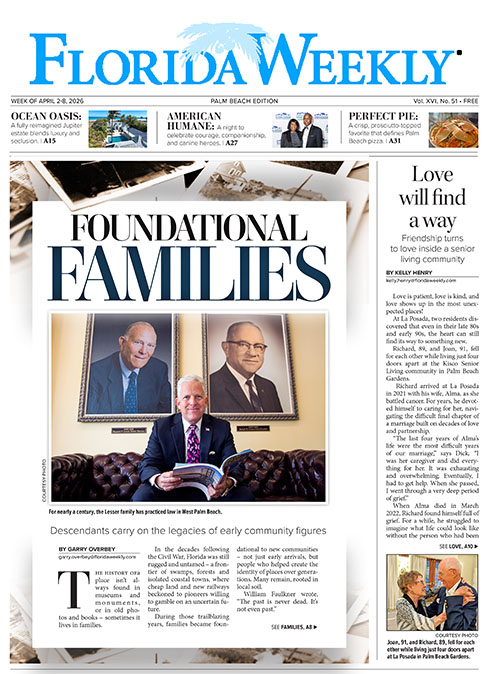
The history of a place isn’t always found in museums and monuments, or in old photos and books – sometimes it lives in families.
In the decades following the Civil War, Florida was still rugged and untamed – a frontier of swamps, forests and isolated coastal towns, where cheap land and new railways beckoned to pioneers willing to gamble on an uncertain future.
During those trailblazing years, families became foundational to new communities – not just early arrivals, but people who helped create the identity of places over generations.
Some families moved on, their branches spread elsewhere. But some have remained, rooted in local soil.
Among them are the legacies profiled here:
Who came seeking open range for their cattle – and carved out an empire.
Who came looking to get rich – and found something more.
Who came to eke out a living in the wild – and helped build a community.
Who came to find a better life amid social injustice – and created a legacy to inspire future generations.
William Faulkner wrote, “The past is never dead. It’s not even past.”
These stories are a window into South Florida’s history. They reveal how – one brick, one plank of wood and one generation at a time – families built the foundations of our communities and continue to shape their structure today.
The Lesser family: A legal legacy in West Palm Beach

For nearly a century, the Lesser family has practiced law in West Palm Beach. -COURTESY PHOTO
For nearly a century, the Lesser family has practiced law in West Palm Beach — a legacy about to span four generations.
Gary Lesser still sees the community where he grew up – despite its population topping 125,000 – as a “big small town.”
“While West Palm Beach has grown a lot, there’s definitely a great degree of connectivity,” Lesser said. “If you meet someone, you’ll find out you have two or three degrees of separation.”
Lesser, 58, is the managing partner at Lesser, Landy, Smith & Siegel, PLLC, a firm his grandfather founded in 1927.

Joseph Lesser founded the firm in West Palm Beach in 1927. -COURTESY PHOTO
Joseph “Joe” Lesser was a lawyer in Rome, Georgia, when a friend told him about a real estate boom in West Palm Beach: “Everyone’s becoming a millionaire.” But as soon as Lesser moved his family to the burgeoning city in 1926, the boom went bust. So he opened a legal practice the following year.
“He was an old country lawyer, and he would help anyone who walked in the door,” Gary Lesser said.
If he believed a client couldn’t pay his fee, he’d ask for a fraction of it. Farmers sometimes paid him in corn.
He was Palm Beach County’s first Jewish attorney. The community’s Jewish population then was very small – about 200 or so.
“Jewish people just kind of found each other,” Gary Lesser said. “And initially they would gather and pray in people’s houses.”
Joseph Lesser was a founder and first president of Temple Beth El, the first Conservative Jewish congregation in Palm Beach County. This year is the synagogue’s 100th anniversary. Lesser also helped establish the local chapter of B’nai B’rith, a Jewish service organization.
With bright blue eyes and a deep Southern drawl, many people didn’t realize Lesser was Jewish unless he told them. Nonetheless, he encountered prejudice.
“He didn’t really believe he faced hatred,” Gary Lesser said. “He thought he faced ignorance.”
He served as counsel for the Salvation Army and president of the Lions Club and remained dedicated to the community throughout his life.
“He thought it was our obligation to help people,” Gary Lesser said. “When I was a little kid, I saw him as a superhero. I said, ‘I want to be just like grandpa.’”

Gary Lesser, (on right), with his dad, is the managing partner at Lesser, Landy, Smith & Siegel, PLLC, a firm his grandfather founded in 1927. -COURTESY PHOTO
Gary Lesser was 14 when his grandfather died in 1982. The funeral was a “packed house.”
“He really loved being a lawyer and helping people,” he said. “My father used to say to me, ‘Damn it, son, you’re just like my father.’ But he meant that as the highest praise.”

Shepard P. “Shep” Lesser joined the firm in 1960. -COURTESY PHOTO
Shepard P. “Shep” Lesser joined the firm in 1960 and brought with him modern touches like air conditioning and electric typewriters. He also held leadership roles in several local nonprofit and community organizations, including Boy Scouts, the Family Services Agency and various Jewish groups. He died in 2020.
Gary Lesser followed into the firm in 1992. It now has branch offices in Stuart, Boca Raton and Wellington.
From 2022-2023, he was president of The Florida Bar, and currently serves on the Board of Trustees of the Florida Supreme Court Historical Society.
Most recently, he founded the Jewish Lawyers Association of Palm Beach County in response to the attacks on Israel on October 7, 2023.
With the firm celebrating its centennial next year, Gary Lesser looks to the future. The oldest of his three daughters, Lillian Lesser – awaiting her Florida Bar exam results – is poised to become the fourth generation of Lessers practicing law in Palm Beach County.
“To have four generations of continuity – as a father, it’s the best thing ever,” he said. “I know how my dad must have felt.”
The Smallwood family: Still standing in the Everglades (on stilts)

The Smallwood Store, now a museum and store, was established in 1906 by Ted Smallwood and served as a trading post with tribes and U.S. Post Office in Chokoloskee, located in Eastern Collier County. -KELLY J FARRELL / FLORIDA WEEKLY
Lynn Smallwood McMillin knew Hurricane Irma was heading toward the Everglades and her lifelong home on Chokoloskee Island. The Smallwood family store – built by her grandfather 100 years before – was in trouble.
“I knew it was going to kick our ass,” she said of the 2017 storm. “And so that was the first time anybody had ever taken anything out of the store – because I was worried we might not have one anymore.”
While securing the store, she went looking for a hatchet.
The Smallwood family had known the Everglades’ Indigenous tribes since her grandfather arrived, and McMillin was a longtime friend of James Billie, former leader of the Seminole Tribe of Florida.
Years before, as a tropical depression approached, Billie tied a hatchet to a chickee hut he’d built at McMillin’s home to, in his words, “split the storm and go around.”
With Irma looming, she called him and said, “I can’t find a hatchet. What can I do?” Billie told her to find “the biggest knife you can” and tie it to a dock piling.Lynn Smallwood-McMillin at the Smallwood Store in Chokolskee in 2024 enjoys telling stories past and present with visitors to the museum. -KELLY J FARRELL / FLORIDA WEEKLYRachel McMillin, a fifth generation Smallwood, sticks her head out the window of the old US Post Office turned Smallwood Store museum in Chokoloskee where she was working in 2024. -KELLY J FARRELL / COURTESY PHOTO
She did, just before the Category 4 storm swept through.
“Well, whenever it was done, that was the piling still left,” she said.
For more than a century, the Smallwood family has remained standing much the same way.
McMillin’s grandfather, Charles Sherod “Ted” Smallwood, came to the Everglades around 1895. He had lived an itinerant life since running away from home in Georgia, with his older brother, while in the third grade.
He worked for a farmer on the Turner River, traveled to Cuba and the Bahamas, and then married the farmer’s daughter. They settled on Chokoloskee Island, which sits on the inside edge of the Ten Thousand Islands – the last stop before the marshes give way to coastal mangrove islands and open Gulf waters.
Smallwood bought half the island. By 1900, he’d made enough money farming to buy the other half.
Anyone traveling between the mainland settlements and the islands would often pass through Chokoloskee. Smallwood opened a trading post in 1906, providing supplies, food and tools for daily life on the remote coast.

Art honoring Susie Billie, a Seminole medicine woman of the Panther Clan, at the Smallwood Store in Chokoloskee shows the integral lives of the Smallwoods and the area tribes, including the Seminole and Miccosukee. -KELLY J FARRELL / FLORIDA WEEKLY
In 1917, to better serve customers coming by boat, Smallwood built a new trading post in its current spot at the water’s edge. The store became a lifeline for the small maritime community built on commercial fishing, boating, trading, farming and hunting. The store also was the island post office, with Smallwood as postmaster.
Smallwood built the store with sturdy Dade County pine, a dense South Florida timber prized by early builders for its resistance to rot, insects and humid weather. When Hurricane Irma struck in 2017, it may have wiped out the dock, but the store survived with minor roof and structural damage – which McMillin attributes to “that Dade County pine.”
To protect against flooding, Smallwood raised the store with 4-foot railroad jacks but realized quickly that wasn’t enough. By 1926, he finally had the store up on pilings about 7 feet off the ground – where it remains.
Smallwood befriended members of the local Seminole and Miccosukee tribes, who had lived in the Everglades since the Seminole Wars of the 1800s. In fact, McMillin said they were one of the reasons her grandfather moved the store.
“My grandfather made it to keep the peace,” she said, telling of how white men would sell moonshine to the natives and then rob them when they passed out. “The Seminoles traded a lot here. They even came from the East Coast, because my grandfather was very good to them, and he tried to help them.”
When McMillin reopened the store around 1989, she was told by some older tribal members that her grandfather was the first white man they’d seen. He was also one of the few they trusted.
McMillin, now 70, a grandmother of seven and a great-grandmother of two, still runs the family store, now a museum and gift shop that also offers boat tours.
Since the establishment of Everglades National Park in 1947, there aren’t a lot of ways left to make a living among the Ten Thousand Islands. While the park protected the ecosystem, it also brought new federal regulations limiting fishing, hunting, land use and development.
“They took our livelihoods away from us,” McMillin said, adding the government seized land through eminent domain. “They took a lot from us to form the park, and they wanted this island, but they couldn’t have it because there was a post office here. If you look at the map, it goes all the way around (the island).”
Life in the area hasn’t changed much in recent decades. McMillin graduated high school in 1974 as one of 28 students – a record, she thinks. She doubts her granddaughter’s senior class is more than 15 to 20.
Yet some things are different. For instance, “the big glow in the sky at night” is no longer Miami – it’s “Alligator Alcatraz,” the detention center for undocumented migrants the state erected last year.
But, just like the dock piling that Irma couldn’t topple, the Smallwood family is still standing.
These days, McMillin can be found at the store that is her family’s legacy, chatting with locals and greeting tourists who want to experience wild Florida.
And they know where to go: From the shore, boaters can enter the maze of tidal creeks, bays and mangrove islands that make up the Ten Thousand Islands.
“A lot of them, they’ve done their research,” McMillin said. “They know we have the best location in the park because we were here first.”
The Hendry family: The cattle king of Fort Myers

The historic Hendry Residence at 1619 Jackson Street in downtown Fort Myers, a symbol of the renowned Hendry family. -DAVID WISHTISCHIN / FLORIDA WEEKLY
When Francis A. “F.A.” Hendry died in 1917, according to legend, Josie Billie – the most powerful of all Seminole medicine men, who was said to be able to call lightning down upon his enemies – walked 80 miles from the Everglades to attend his funeral.
Decades earlier, Hendry let Billie’s father – Billie Conapatchee, or “Billy Corn Patch” – live with his family while the young man learned to read and write.
As both the region’s largest cattle rancher and a state lawmaker, Hendry was a friend to the Seminole people, even after serving in the Seminole Wars of decades earlier.
Harry Hendry, 73, grew up hearing this and other stories about his legendary ancestor, Francis Asbury Hendry – a founding father of Lee County, who built a cattle empire out of Fort Myers and left his family’s brand on Southwest Florida.
Today, the Hendry family tree spreads so far throughout Florida that Harry Hendry can barely begin to trace its branches.
“One thing that I’m finding interesting in my old age is just this whole spider web of family relationships all over the state,” said the great-great-grandson of F.A. Hendry. “We’d have a family reunion and 150 people would be there.”
A retired attorney, he once looked up how many kin worked in the legal profession: “It was enough to start our own bar association.”
He’s related to just about every cattle family in Florida, and he’s met Hendrys as far away as Tennessee.
Their Florida heritage began around 1850, with about 3,000 head of cattle and a long trail drive.

Hendry St. and Main St. of downtown Fort Myers. -DAVID WISHTISCHIN / FLORIDA WEEKLY
“We basically moved west across Georgia, staying ahead of civilization until we got to Thomasville, and then the decision was made to go down into Florida,” Harry Hendry said. “Basically, nobody was in Florida then.”
They settled on the Alafia River, 22 miles east of Tampa. In 1852, when his father died while settling affairs in Georgia, 19-year-old F.A. Hendry, nicknamed “Berry,” decided the family would stay. He married, moved to Fort Meade and started a cattle ranch.
He served in the Third Seminole War and in the Confederate Army during the Civil War. As the Union Army tried to control the state’s beef supply, Hendry joined the “Cow Cavalry” that attacked the Fort Myers army post on Feb. 2, 1865. The Battle of Fort Myers, the southernmost land battle of the Civil War, ended with a Union victory.
“I don’t think they were die-hard Confederates,” Harry Hendry said of the Cow Cavalry. “Their real intention was to keep the cattle herds together until the war was over.”
After the war, F.A. Hendry brought his extended family and 12,000 head of cattle to the now-abandoned Fort Myers. Harry Hendry thinks they were the third family in the settlement.
From Fort Myers, Hendry soon became one of the state’s most successful cattle ranchers. He helped spearhead the lucrative Cuban cattle trade, widely credited with rebuilding Florida’s economy after the Civil War, when Confederate currency became worthless.
Between 1868 and 1878, more than 1.6 million head of cattle were shipped from Punta Rassa to Havana. F.A. Hendry sent 10,000 to 15,000 cattle a year, Harry Hendry estimated.
“The Spanish cattle buyers paid in gold, and so all of these early cattlemen became immensely wealthy and started paving the streets in Fort Myers and putting up brick buildings and becoming storekeepers and hotel operators,” he said.
By 1876, his herd had grown to 50,000, spread among 25,000 acres of fenced-in range land. Beef was now Florida’s primary crop.
“I once read an article he wrote about the benefits of being a cattle person, because the cows made money all year round, in the sense of having calves that you could sell,” Harry Hendry said. “They didn’t need a lot of attention. That gave him plenty of time to engage in local politics.”
Hendry chaired the meeting in 1885 where residents voted to incorporate the city of Fort Myers.
Fort Myers was then part of Monroe County, which covered all of Southwest Florida from Charlotte Harbor to the Florida Keys. Residents wanted to change that.
“You had to take a schooner to Key West to see your county commissioners back then,” Harry Hendry said.
The last straw: Commissioners blamed locals for a schoolhouse fire and refused to rebuild it.
Lee County – named for Confederate Gen. Robert E. Lee – was established in 1887, with Hendry as one of its first commissioners.
Other relatives followed into politics and business, such as opening Lee County’s first banks. One of F.A.’s sons expanded the old family home into a hotel.
“They just had their finger in everything that was going on,” Harry Hendry said.
Hendry advocated for the region in Tallahassee, serving multiple terms in both the Florida Senate and House of Representatives.
The family’s wealth helped to transform Fort Myers from a rural outpost to a growing town. The Hendrys were among the first families in the area to drive cars and enjoy many new conveniences.
Occasionally, Harry Hendry is asked to speak to community groups about his family and their history – in many ways, also the history of Fort Myers.
When looking at a street or building, he’ll recall some bit of family lore. Streets lined with royal palms, for instance, conjure stories of his great-grandfather, James Hendry, a nursery owner who first transported the regal trees from Cuba on a schooner.
“Well, I sometimes feel like I’ve got a protective interest in it,” he said of the community that is still his home.
He felt that protective ache in 2022 while watching, from his mother’s farm in Ohio, as Hurricane Ian devastated Lee County.
“We still haven’t recovered,” he said.
Hurricanes can flood streets and rip apart buildings, but they can’t erase the Hendry legacy in Southwest Florida.
In the 1890s, F.A. Hendry platted land for a new city. Combining the names of his daughters, Laura and Belle, LaBelle is now the county seat of Hendry County – which the state named in his honor in 1923.
Hendry’s former home in LaBelle was added to the National Register of Historic Places in 1998.
Berry Hendry, the name of a branch of the Peace River, flows near where he had a cabin and land – an epitaph written in water.
Martha Bireda’s family: Keepers of Punta Gorda’s Black history

Marth Bireda stands at the historic Blanchard House in Punta Gorda with Jaha Cummings. -GARRY OVERBEY / FLORIDA WEEKLY
“This is untold and untaught history, young man.” Martha Bireda speaks to a teenage boy visiting the Blanchard House Museum. “You have not gotten this in school.”
The boy and his family have stopped at the museum – one of only two in Southwest Florida devoted to Black history.
As they look around, Bireda describes Punta Gorda’s beginnings as a biracial community.
“The two groups worked together to make Punta Gorda the town that it is,” Bireda says.
“The railroad was brought here by colored men. So, take a look at how this little town, different from everywhere else, developed because of the relationships between white and colored.”

Martha Bireda, 80, the museum’s executive director of the Blanchard House Museum, is a seventh-generation Floridian and fourth-generation Punta Gorda resident. -GARRY OVERBEY / FLORIDA WEEKLY
The museum – in a century-old home on a quiet Punta Gorda street – is more than a collection of photographs, artifacts and oral histories. It’s a dream made real.
The dream belonged to Bireda’s mother, Bernice Russell. An activist, historian and volunteer in Charlotte County, Russell worried young people didn’t know the stories of their heritage.
“She noticed some of the kids had their heads turned down,” Bireda said. “And that’s where the museum came from – for the youth to really know their history and be proud of who they were.”
Bireda, 80, the museum’s executive director, is a seventh-generation Floridian and fourth-generation Punta Gorda resident. Her son, Jaha Cummings, is the next generation. In addition to helping his mother run the museum, he’s overseeing its new expansion. And, inspired by his grandmother and mother’s dream, he founded the Blanchard House Institute, a nationwide project to revitalize neglected communities.
Both mother and son believe Punta Gorda’s early years show that unity is possible.
Founded in the 1880s as Trabue, Punta Gorda was mainly a fishing village until the Florida Southern Railroad made it the southernmost station on the west coast – turning it into a shipping point for cattle, fish and other goods.
Needing land surveyors, engineer Albert W. Gilchrist, a future state governor, picked seven men – all Black. Among them was Dan Smith, Bireda’s great-uncle. The 20-year-old child of an ex-slave, he arrived in Punta Gorda in 1885 unable to read or write. Yet Gilchrist recognized him as a “math genius,” Bireda said.
“He didn’t believe in that narrative about the inferiority of African American men,” she said. “And so, he chose seven colored men and trained them to be the survey team to bring the railroad to Punta Gorda.”
The survey crew increased the male population from eight white men to 15. Black residents accounted for nearly half the city’s population until the 1950s, according to Cummings.
By 1886, the railroad was completed with the labor of 200 Black men. Almost overnight, Punta Gorda became a bustling port town of settlers, merchants and laborers – including Black families who, despite Jim Crow laws, built neighborhoods, churches and schools.
The museum devotes considerable space to Smith. As a community leader, he held the first religious services in Punta Gorda – welcoming both Christians and Jews under a palmetto-thatched roof – and helped establish the first Black church, Bethel AME. He also recruited the city’s first Black teacher, Benjamin J. Baker.
Punta Gorda families valued education from the beginning, Bireda said. Smith, enrolled in the Black school with other adults, learned to read alongside children. Two of his daughters would go on to become math teachers, and three grandchildren became engineers.
Bireda’s great-grandmother was Queen Evans, a South Carolina arrival, whose sister married Smith. At a church “toe party” – a courtship tradition where men chose women hidden behind a sheet, visible only by their toes – she met James Andrews. They soon married.
“It’s my belief,” Bireda said, “that Dan Smith let [Andrews] know which girl to choose.”

Martha Bireda, a foundational family of Punta Gorda, and teller of its history. -GARRY OVERBEY / FLORIDA WEEKLY
Andrews, the city ice plant’s first Black firefighter, was involved in business ventures such as fishing and orange groves. Prosperity allowed her grandparents to enjoy a higher status in what Bireda called a “colored society.”
“The colored women married to fishermen here did not work,” Bireda said. “Life was good. On Sundays, the women dressed up and would take excursions to Boca Grande. Queen, or Queenie, raised lavender, had a piano, had China – they had a very good life.”
Born in Arcadia in 1945, Bireda spent much of her childhood in the Appalachian Mountains where her father was born. Moving back to Punta Gorda at age 10, she attended segregated schools. Bireda attributes Charlotte High School’s voluntary desegregation in 1964 to Punta Gorda’s earlier biracial unity.
She studied speech and hearing pathology in college, eventually earning a Ph.D. Working as a speech therapist at the University of Miami, a client with a stutter one day offered her a rose. She married him and gave birth to her son. After a second marriage and her daughter’s birth, Bireda returned to Punta Gorda.
In the 1980s, her mother, Bernice Russell, created a traveling Black history exhibition.
With a vision to create a museum celebrating local Black history, Russell purchased the historic Blanchard House at a tax sale in 1997. One of the few remaining examples of a Florida vernacular-style Craftsman bungalow, it was built in 1925 for a local fisherman and his mail-order bride.

A framed photograph of Bernice Russell, who had purchased the historic Blanchard House in 1997. -GARRY OVERBEY / FLORIDA WEEKLY
“I used to type Mrs. Blanchard’s Christmas cards for a dollar,” Bireda recalled.
When Russell died in 1999, Bireda adopted her mother’s vision. Finally, after moving the home to Martin Luther King Jr. Boulevard in 2002, the Blanchard House Museum opened in 2004.
Within months, damage from Hurricane Charley forced it to close for two years. It closed again, from 2022 to late 2025, for repairs due to Hurricane Ian.
After 22 years, the museum will soon expand with the addition of another historic home – the Jean Cleveland House, named for a longtime city clerk who worked with Russell to preserve local history.
“So we say, in life they worked together, and now in death they work together,” said Cummings.
Planned to open later this year, the refurbished home will be called the Cultural Heritage Center. Cummings said it will combine a youth museum showcasing Florida’s cultural diversity with a senior center to fill the void left by the storm-wrecked Cultural Center. Also, he hopes to bring adult education classes back to Charlotte County.
“This is one of the missions – to create this intergenerational space,” Cummings said. “On one hand, it’s introducing our young people to our history, but also a place where our older residents can socialize and be together.”
After college, Cummings spent 20 years abroad as a consultant. A trip home led him to stay and become involved in civic affairs. He served three terms on the Punta Gorda City Council and now sits on the boards of several organizations.
Cummings said more places could learn from Punta Gorda’s origins.

Martha Bireda and Jaha Cummings stand before a wall of photographs and history in Punta Gorda. -GARRY OVERBEY / FLORIDA WEEKLY
“In the late 1880s, Florida, without question, had the strictest Jim Crow laws in the country. Despite that, we still did this,” Cummings said. “We’ve proven in, honestly, much tougher times that we don’t have to have these divisions. So that’s something we hope to share. Punta Gorda’s story is something that can be a national model.”
Both mother and son noted the museum display on George Brown, a Black shipbuilder and one of Punta Gorda’s wealthiest citizens. Employing workers of both races at fair wages, he was “arguably the first” equal-opportunity employer in the state, Cummings said. When he died in 1951, Brown reportedly owned half the land in the city.
In other communities, racial division might have destroyed Brown’s shipyard. But not in Punta Gorda, which Bireda called “a model of what a beloved community could be.”
“We call ourselves the legacy community because we are the children, the descendants of the first pioneers,” she said. “We truly are a model. Just by letting everybody use their gifts and skills, everybody benefits. Ignorance divides, but knowledge brings us together.”