
When a medical mistake changes the course of a family’s life, the case requires more than legal knowledge. It requires experience, medical insight, compassion, patience and the willingness to take on some of the most complex cases in personal injury law.
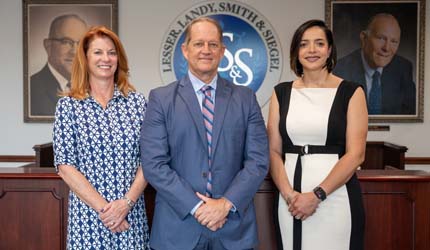
That is the work being done by the Catastrophic Medical Malpractice Team at Lesser, Landy, Smith & Siegel – Florida Injury Lawyers, led by Firm Partner Mike Baxter, with Nurse Paralegal Eileen Bajak and Paralegal Deysy Garcia. As the team marks its one-year anniversary with the firm, their work reflects our nearly century-long commitment to helping people through some of the most difficult moments of their lives.
Catastrophic medical malpractice cases involve life-changing harm caused by medical negligence. These are not minor mistakes or temporary injuries. They often involve death, brain injury, paralysis, loss of limb, severe surgical complications, injuries to babies or children, or other permanent injuries that fundamentally alter a person’s life and future.
For Firm Partner Mike Baxter, these cases require more than a basic understanding of medical malpractice law. They require trial experience, deep knowledge of medicine, the resources to thoroughly investigate the claim, and the ability to anticipate exactly how hospitals, insurance companies and defense attorneys will respond.
Before representing victims of medical negligence, Baxter spent 16 years defending hospitals and healthcare providers. That experience gives him a rare and powerful perspective when evaluating and preparing catastrophic medical malpractice cases for injured patients and their families.
“I have the perspective of somebody who successfully defended hospitals and health care providers for 16 years,” Baxter said. “I’m already trained to think about what the other side is going to argue.”
That insight shapes every case he accepts. Baxter knows how hospitals evaluate risk, how defense lawyers prepare their arguments, and how insurance companies assess exposure. He also knows what it takes to prove a case from the inside out.
Medical malpractice cases are among the most challenging in personal injury law. Before a lawsuit can be filed, the team must collect and analyze medical records, identify the proper defendants, consult with medical experts, and complete Florida’s required pre-suit investigation process. Baxter said the average case can take two and a half-to-three years from initial investigation to resolution.
That is why the team is highly selective about the cases it accepts. The harm must be catastrophic, and the evidence must support the claim.
Baxter began his legal career as a prosecutor in Miami, where he tried close to 100 cases in three years and developed the courtroom experience that continues to define his practice today. He later transitioned into medical malpractice defense, representing hospitals and healthcare providers for more than a decade. Over time, however, he began to see the work differently. He saw valid cases where injured people had real losses, but the system failed to deliver accountability. He also saw the healthcare and insurance industries become increasingly corporate and driven by analytics rather than relationships, accountability and doing what was right.
Eventually, Baxter made a purposeful shift to representing injured patients and families.
“I think I’m one of the few attorneys in the state who has had as many medical malpractice trials for both plaintiffs and defendants, and had as much success as I’ve had,” Baxter said.
Today, that experience is an advantage for his clients. Baxter approaches each case by pressure-testing the medicine, challenging his own experts before the defense ever has the chance and preparing every case as though it will be tried in front of a jury.
His trial record includes significant verdicts in complex medical malpractice cases. In 2024, Baxter obtained a $3.2 million verdict in Martin County for a man who lost his leg due to an untreated infection. With costs and interest, the final judgment was approximately $3.8 million. In another case in Palm Beach County involving an interventional cardiologist, Baxter obtained a $4 million jury verdict for the family of a 72-year-old man who died after a cardiac procedure. That case later resolved for more than the verdict amount.
For Baxter, the results matter, but so does the reason behind the work.
“I’m really enjoying it now because of the value that I feel like it brings to my clients, but also to my life,” Baxter said. “It gives me meaning and purpose.”
How Medical Insight Strengthens the Team’s Case Preparation
A critical part of the Catastrophic Medical Malpractice team’s strength is Nurse Paralegal Eileen Bajak’s medical background. A registered nurse with a master’s degree in nursing, Bajak has spent more than 20 years in healthcare, including 15 years working as a NICU nurse. She also has experience in nursing leadership and administration, giving her a deep understanding of how hospitals operate, how nurses are trained, how policies should be followed and where systems can break down.
Bajak and Baxter’s working relationship is built on years of trust. The two first met through their daughters, who played soccer together, and later connected professionally when Baxter recognized how valuable Bajak’s nursing background would be in catastrophic medical malpractice cases. They have now worked together for six years, combining Baxter’s trial experience and defense-side insight with Bajak’s clinical training and firsthand understanding of patient care.
Bajak looks at cases differently than a lawyer. She reads medical records through the lens of someone who has spent decades inside hospitals caring for patients. She understands how bedside decisions are made, how communication should flow between providers, what proper documentation should look like and how hospital systems are designed to protect patients before harm occurs.
“I’m able to assist Mike with looking at the deviations in the standard of care by any type of medical provider, whether it’s a doctor or a nurse,” Bajak said.
In her experience, one of the most common failures in catastrophic medical malpractice cases is communication. Breakdowns between providers, failures to understand a patient’s symptoms, lack of continuity of care, inadequate documentation and failure to act on warning signs can all lead to devastating outcomes.
“Catastrophic medical malpractice would not be a mistake,” Bajak said. “It is something that happens when there’s a failure in the system that just keeps snowballing until it gets to the patient and it affects them at a catastrophic level.”
That perspective is especially important in cases involving babies, children and hospital systems. As a NICU nurse, Bajak understands not only the medicine, but also the fear families experience when something goes wrong. She knows what communication should look like. She knows how nurses are supposed to advocate for patients. And she knows how devastating it is when systems fail both patients and providers.
“When the systems have failed, especially when it affects how nurses do their jobs, it hurts me to the core,” she said.
Guiding Clients Through the Most Difficult Chapters of Their Lives
Paralegal Deysy Garcia brings another essential strength to the team: client connection. A paralegal with more than 13 years of legal experience, Garcia has worked with Baxter since 2019. She describes catastrophic medical malpractice work as the most rewarding area of law she has worked in.
The reason is simple: The clients.
Garcia is often the person clients speak with most regularly. She helps guide them through the discovery process, gathers deeply personal information, answers questions and stays in close contact throughout cases that can last years. In these cases, she said, clients are often dealing with the worst thing that has ever happened to them. Many are grieving. Others are living with permanent injuries or caring for loved ones whose lives will never be the same.
“My clients essentially become like family to us,” Garcia said. “When we get them compensation, even though it doesn’t change their circumstances, they’re overwhelmingly thankful.”
Garcia said clients often remain in touch long after their cases are resolved. One former client contacted her years later to share the news of a grandchild’s birth. Another family received support from Garcia and Bajak during a mental health crisis involving a young survivor. For Garcia, those moments show the difference between processing a case and truly caring for a family.
“That’s the kind of things we do for our clients that I think definitely sets us apart,” Garcia said.
Together, Baxter, Bajak and Garcia form a team built for high-stakes cases. They are selective about the cases they accept, which allows them to devote significant time and attention to each client and each claim. Baxter said the team does not operate like a volume practice. They work up cases in detail, learn the medicine, anticipate the defense and prepare as though trial is likely unless the defendant offers a fair resolution.
“We’re very particular about the cases that we do take,” Baxter said. “We don’t handle a high caseload, so that way, we can give our clients all of our time.”
That approach is consistent with the culture of Lesser, Landy, Smith & Siegel. The firm does not rely on billboards or television advertising. It relies on relationships, reputation, results and the trust of clients, referring attorneys and the community. For nearly a century, the firm has built its reputation by providing personal attention, direct attorney access and strong advocacy for the injured and their families.
For families facing catastrophic medical malpractice, that personal attention matters. These cases are not just about medical records or expert opinions. They are about spouses, children, parents and families whose lives have been permanently changed. They are about understanding what was lost and fighting for accountability.
As the team reflects on its first year with the firm, Baxter said the opportunity has been meaningful both professionally and personally.
“It’s been a year and it’s flown by,” Baxter said. “I’m so lucky and blessed to be here. It was an opportunity that I had not expected, but it was one that I jumped at because I know the lawyers here. I know Gary Lesser, I know Joe Landy, I know Glenn Siegel, and they’re all friends first.”
For Baxter, the work comes back to the firm’s mission.
“The firm’s mission is to help people,” Baxter said. “And really, that’s why, ultimately, we do what we do.”